Publications / 2025
M2H: Multi-Task Learning with Efficient Window-Based Cross-Task Attention for Monocular Spatial Perception
IEEE/RSJ International Conference on Intelligent Robots and Systems (IROS) 2025
Four dense prediction tasks share one small model and make each other better, fast enough to sit inside a mapping loop.
Context
Mono-Hydra ran an independent depth network and an independent semantic network side by side. That duplicates compute and produces two representations that do not agree with each other. M2H replaces both with one multi-task model in which depth, semantics, surface normals, and edges exchange information through window-based cross-task attention.
Contribution
A window-based cross-task attention module that lets tasks exchange structured features while keeping task-specific detail, on a DINOv2-small backbone. In the ablation both the local attention and the global fusion module matter: removing either degrades every task.
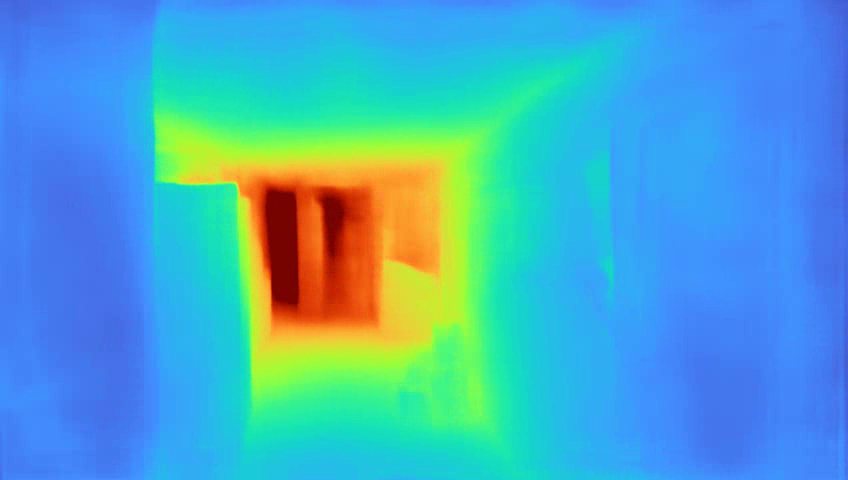
ITC building corridor


Results
- 61.54 mIoU, 0.4196 RMSE NYUDv2 semantic segmentation and depth RTX 3080 laptop. Best prior compared: SwinMTL 58.14 mIoU, MTMamba++ 0.4818 RMSE.
- 0.11 m at 30 fps ITC building 2nd floor mesh mean error, in the Mono-Hydra loop 224x224, RTX 3080 laptop. The Mono-Hydra baseline with separate networks reached 0.19 m at 15 fps.
- +5.65 mIoU Hypersim semantic segmentation over EMSANet 52.31 against 46.66, Table II. Depth RMSE 3.19 against ScaleDepth-NK at 4.825.
Datasets: NYUDv2, Hypersim V1, Cityscapes, ITC building (own capture). Hardware: Trained on A40. Tested on RTX 3080 laptop, 30 fps.
Limitations
- M2H is 81 M parameters and 488 GFLOPs. The parameter count is moderate but the GFLOP count is high.
- M2H-small is far cheaper at 33.7 M parameters and 59 GFLOPs, and gives up 3.49 mIoU (58.05 against 61.54).
- Boundary detection on NYUDv2 is the one task where the small variant falls behind prior work, at 74.44 odsF.